


Catholic leaders urge prayer after horrific Orlando shooting
Orlando, Fla., Jun 12, 2016 / 10:19 am (CNA) - Following Saturday night's shooting at a nightclub in Orlando that killed 50 people, Catholic leaders from around the U.S. are offering prayers for the victims and their families.
“Waking up to the unspeakable violence in Orlando reminds us of how precious human life is,” said Archbishop Joseph Kurtz, president of the U.S. Catholic bishops conference, in a statement.
“Our prayers are with the victims, their families and all those affected by this terrible act.”
In the early hours of June 12, a gunman identified as 29-year-old Omar Mateen exchanged fire with a police officer working at Pulse nightclub, which has a predominantly gay clientele.
Mateen, who was from Florida and was of Afghan descent, took hostages for as much as three hours, and was shot to death by Swat officers. Though the mass violence is thought to be ideologically motivated, he was not known to have links to any terrorist groups.
Another 53 persons were injured in the shooting.
The death toll makes the Orlando shooting the worst in United States history.
“We pray for victims of the mass shooting in Orlando this morning, their families & our first responders. May the Lord's Mercy be upon us,” Bishop John Noonan of Orlando tweeted June 12.
Bishop Noonan was joined in mourning and prayer by Bishop James Conley of Lincoln, who tweeted: “Please join me in praying for the victims of violence, and their families and loved ones, in Orlando.”
Bishop William Lori of Baltimore also voiced his grief over the shooting in a tweet sent from his archdiocese, asking as well for prayers for the victims.
In his statement, Archbishop Kurtz wrote that the “merciful love of Christ calls us to solidarity with the suffering and to ever greater resolve in protecting the life and dignity of every person.”
USCCB President @ArchbishopKurtz Reacts to “Unspeakable Violence” in Orlando; Offers Prayers for the Victims pic.twitter.com/j6YoQkgELX
— US Catholic Bishops (@USCCB) June 12, 2016
What Catholics are doing to help victims of predatory loans
Washington D.C., Jun 5, 2016 / 04:44 pm (CNA) - As the federal government considers regulating the infamous “payday loan” industry, Catholics are already acting to help borrowers saddled with loan debt.
“I think that, from a social justice standpoint, we have the ability to speak for an entire group of people who are being marginalized and taken advantage of,” Stacy Ehrlich, executive director of the Society of St. Vincent de Paul for the Diocesan Council of Austin, told CNA in an interview about the society’s predatory loan conversion program.
The program allows people burdened with one or several onerous short-term loans to pay them off with a low-interest loan from a local credit union. The program exists “to offer some sort of resolution” for borrowers who are “being preyed upon,” Ehrlich explained.
Payday loans and similar types of loans have been criticized as capitalizing on people in desperate situations by charging exorbitant interest rates and fees in terms that customers often do not fully understand and to people who may have no other choice but to take the loan despite the extreme conditions.
Although the rise in “payday loans” is a recent phenomenon, there is a history of “loan sharks” in the U.S. that goes back much further. The basic idea is the same, however: for borrowers who are often strapped for cash and have an emergency expense, lenders offer a small amount of money for a short period of time – until the next paycheck, for example – but attach high interest rates or high “rollover” fees.
With all the fees taken into account, these loans can carry annual interest rates approaching 400 percent, the Consumer Financial Protection Bureau notes.
Some people are able to pay off such a loan quickly, but the process often ends in debt for the borrower, said Dr. Robert Mayer, a professor of political theory at Loyola University Chicago who authored the book “Quick Cash: the story of the loan shark.”
People take out payday loans because they are “speedy” and “convenient” where “relatively few questions are asked,” Mayer told CNA.
A typical borrower is not necessarily among the “poorest of the poor” who has no credit, he noted, but can be a low-to-middle income working-class person without sufficient savings who needs “fast credit,” perhaps for an emergency expense like a car repair or dental work.
“I think the way household finances work these days, people are living from paycheck to paycheck,” he said, “so a bridge loan that’s convenient, in which people can think they can pay back quickly, can make a lot of sense for people, the way they get started.”
Other borrowers can be simply be those with little to no financial knowledge who are the “ultimate optimists” because they think that their situation – like a part-time job, for example -- will be good enough to pay off a short-term loan, Ehrlich said.
However, because of high rates of interest or fees that are attached to a loan which rolls over to the next pay period, loans not paid off quickly can increase rapidly. The consequences can be serious – many borrowers can go further into debt or face debt collection or asset seizure, the Consumer Financial Protection Bureau says.
Lenders can have access to borrowers’ bank accounts, and if their accounts have insufficient funds to pay the loan, overdraft fees can compound the costs. Thus, those without sufficient financial knowledge, or those without savings who need fast cash to pay for an emergency, can easily become trapped in nasty debt.
The Church has “definitely” been a leader in pushing for reform of the payday loan industry and has historically spoken out against usury, safe Mayer.
In November of 2013, Bishop Stephen Blaire of Stockton, then-chair of the committee on domestic justice and human development for the U.S. bishops’ conference, wrote the head of the Consumer Financial Protection Bureau about payday lending abuses.
Most payday loans are used “to meet recurring, basic needs,” he wrote, but they “are structured in such a way as to make repayment very difficult, initiating a cycle of deeper indebtedness that adds to borrowers’ financial stress, rather than relieving it.”
Such lending is immoral because it “preys on the financial hardship of poor and vulnerable consumers, exploits their lack of understanding, and increases economic insecurity,” he said.
And bishops elsewhere have fought for payday loan reforms, like in Texas, where the state’s Catholic Conference has pushed for regulations at the state legislature.
On Thursday, the Consumer Financial Protection Bureau proposed new regulations of the payday loan industry. Companies, before lending, must conclude that the borrower is capable of paying back the loan. There are other proposals, like limits on the number of times a lender could access a borrower’s bank account to prevent overdraft fees from piling up if the account has insufficient funds.
Regulations could successfully curb lending abuses, Dr. Mayer said, but they could also carry adverse consequences for some people needing a fast line of credit.
“Insofar as lenders are being forced to be more responsible or more cautious,” he noted, “that can help prevent people from getting trapped in cycles of debt, as long as loopholes don’t open up.”
However, he added, “some people will lose access to emergency credit,” including perhaps those who have successfully paid off such loans in the past without incurring large amounts of debt.
This is where the Church and faith-based organizations could step in to help those who need emergency cash at a low cost. And some groups are already doing just that.
The Society of St. Vincent de Paul in Austin started its loan conversion program in 2014 under Bishop Joe Vasquez, a leading voice for predatory loan reform in the state, after he encouraged them to actively help those saddled with debt.
“We also felt like there needed to be a little bit of money where our mouth was,” Ehrlich said, noting “that calling to be actionable and not just talk.”
Although in Texas there is a cap on the direct interest rate for a loan, there are no limits on “rollover renewals,” Ehrlich said, meaning that despite seemingly innocuous interest rates, hidden costs on loans can add up with each session.
For instance, a two-week loan might have an advertised 10 percent interest rate with a $50 paperwork fee, Ehrlich said. However, for each period that loan is not paid, another $50 paperwork fee is added on to the outstanding payment. Over the course of several weeks, that cost can easily balloon into a debt that is enormous for someone with a limited budget or irregular income.
With all the costs and fees included, the average annual interest rate for a loan ends up at an astonishing 303 percent, Ehrlich said. “300 percent interest rate for anyone is just not sustainable,” she insisted.
The society partnered with a local credit union shared-loan program, offering short-term low-interest loans to people who need to pay off their payday loans. They made their first loan in April of 2014 and the program took off later in the summer.
With $100,000 the society raised, the money acts as collateral to guarantee loan payments. The loans are offered at 2.5 percent annual interest, enough to cover operating costs. Neither the credit union nor the society profits from the endeavor, Ehrlich said.
Since the start in 2014, 88 loans of 54 people have been converted, she noted; borrowers often have several loans out at a time, and may take out one loan to pay off another. The average loan size is $720.
The society does its due diligence at first by determining the ability of a borrower to pay back a loan. They must have a “sustainable source of income,” Ehrlich noted, and room in their budget for a loan payment. Oftentimes people forget their normal living expenses like mortgages, rent payments, and groceries when taking out a loan.
In addition, the society offers a financial literacy course for borrowers; if they complete the course and pay off their loan, they receive 10 percent of the original amount back.
Ultimately, Ehrlich sees the society’s work as protecting the vulnerable. “I think it’s the recognition that we need to do everything we possibly can to give voice to people who have no voice,” she said.
How Muhammad Ali inspired hope in those who suffered
Denver, Colo., Jun 6, 2016 / 05:09 pm (CNA/EWTN News) - On January 19, 1981, in Los Angeles, Muhammad Ali talked a man down from jumping off a ninth-floor fire escape, an event that made national news.
“Former heavyweight champions slip out of the news as easily as ex-presidents, but Muhammad Ali was never your garden-variety champion of all the world,” Walter Cronkite said on the Jan. 20, 1981, edition of the CBS Evening News. “Yesterday in Los Angeles, he responded like a superhero when a distraught man threatened suicide.”
Ali told the distraught man that he was his brother, that he loved him and wanted to take him home to meet his friends. After half an hour, Ali had his arm around the man’s shoulder and led him to safety.
While boxing legend Muhammad Ali will go down in history as “The Greatest” fighter, some of his greatest fights – for hope, courage, and human dignity – took place outside the ring.
In 1984, at the age of 42 and just a few years into retirement from boxing, Ali was diagnosed with Parkinson’s disease. Never one to accept defeat and with a keen ability to inspire hope in others, Ali used his diagnosis to raise awareness and funding for research on the progressive neurological disease.
But it was not just his fighting attitude, but his religious belief, that kept him moving forward.
Dawud Walid, Executive Director of the Michigan chapter of the Council on American-Islamic Relations (CAIR), said Ali’s trust in God helped his perspective after receiving what would be a devastating diagnosis for someone who had been so active.
“He reflected a very strong faith in the face of that debilitating disease,” Walid told CNA.
“I remember him saying that he was humbled by God allowing him to have a disease, to show him who was really the greatest, that God is the greatest,” he said. “(Ali) would say there was a hidden blessing in it.”
By being so public about his diagnosis, Walid said Ali was able to show the world that one can still have courage and hope in the face of suffering.
“I remember him lighting the Olympic flame in Atlanta, and he struggled and he was there shaking but it was really a sign of courage and a sign of hope not just to people who are struggling with Parkinson’s disease, but other diseases, that you still can have dignity in the face of such enormous challenges,” Walid said.
“A diagnosis of Parkinson’s disease or another movement disorder is not a death sentence,” reads a statement on Muhammad Ali Parkinson’s Center website.
The site also posted a tribute video to Ali, who died Friday at the age of 74, after a 32-year battle with Parkinson’s disease.
Parkinson’s patients in the video recall how Ali’s courage and generosity in the face of suffering changed their lives.
“I had no idea how much of a difference Muhammad Ali would make in my life. Now that I have Parkinson's disease, his generosity has been a blessing for me personally,” a man says in the video.
“He never said ‘I can’t do this’, so that has become my motto too,” another patient says.
Besides his fighting record, charisma, and Parkinson’s advocacy, Ali is also remembered for his peaceful, although controversial, protest and resistance of the draft for the Vietnam war. Ali cited his Islamic religious beliefs, as well as racism, as his reasons for being a conscientious objector. He was arrested for draft evasion and unable to fight for four years while his case went through appeals court.
His appeal took four years to reach the U.S. Supreme Court, which in June 1971 reversed the conviction in a unanimous decision that found the Department of Justice had improperly told the draft board that Ali's stance wasn't motivated by religious belief.
Ali, who was born Cassius Marcellus Clay, changed his name when, inspired by Malcolm X, he converted to the Nation of Islam, a controversial American Muslim sect that advocated racial separation and rejected the pacifism of most civil rights activism. He later switched to the more mainstream Sunni Islam.
Walid said that Ali openly talked about his belief in God and the virtues contained in all the world’s religions.
“He believed that if people lived by those virtues, especially the Golden Rule, then this earth would be a much better place.”
During his life, Ali met with religious people and leaders throughout the world of various persuasions and denominations, including, in 1982, St. John Paul II.
A sports fan himself, and an eventual Parkinson’s suffer as well, John Paul II exchanged autographs with the famed boxer during a private audience at the Vatican.
His legend for the Muslim community, Walid said, will be his non-violent protests and his bold but peaceful activism.
“We live in a society now in which people are now provoking violence and meeting those provocations with violence,” Walid said. “Muhammad Ali stood strong for his Islamic belief and against the unjust war in Vietnam, but he was peaceful in that regard.”
“Inside the ring he was a gladiator, and outside of the ring, he appealed to people’s moral consciousness,” he said.
“Given the era that Ali came from and the boldness and the resilience that he exhibited, it is doubtful that the American Muslim community will ever see the likes of an American Muslim like Muhammad Ali in our lifetime.”
How Pope Francis inspired a Thailand parish to plant 800 trees
Bangkok, Thailand, Jun 8, 2016 / 12:36 am (CNA) - Inspired by Pope Francis’ encyclical on caring for creation, and concerned by environmental threats around them, Catholic parishioners in Thailand are planting hundreds of new trees.
“Pope Francis has enlightened us and appealed to us in his encyclical ‘Laudato Sì’ for collective action and bold cultural revolution to tackle environmental issues,” said Father Daniel Khuan Thinwan.
“As pastors it’s our responsibility to take these teachings to the peripheries so that the faithful can find their true meaning in practice,” he told CNA June 6.
The priest is from Mount Carmel Church in Paphanawan in the Diocese of Thare and Nonseng in the far northeastern region of Thailand. The parish community’s reforestation program planted 800 saplings to celebrate World Environment Day, held on June 5.
“Pope Francis has touched the key points of the environment, which has been a universal reality and especially in the local area a challenge,” Fr. Daniel said. “The question is: how to put these teachings into reality?”
The Thai priest said that environmental and climate change discussions had been mainly confined to scientists, activists, universities, and others engaged in politics and economics. Pope Francis has opened a new dimension on the issues and brought a broader perspective, engaging the question with the eyes of spirituality and faith, he added.
For the reforestation program, families helped grow plant saplings and brought them to the church. After Sunday Mass, young and old began digging and planting the saplings to help replenish the forest and bring greener plant life to the hills. The monsoon season is gradually picking up its pace, and the rains will naturally help the plants to grow.
The trees will help contain air pollution, prevent soil erosion and maintain soil fertility. They will also give new life to wild flora and shelter to animals and birds. The trees will help bring rain and maintain temperature and ground water level in the area.
Fr. Daniel said the effort is “a small step which will help to make an impact on climate change for a better world.”
“We need to tackle these issues and challenges before it too late to save our planet, our ‘common home’.”
The priest said that the parish catechesis on “Laudato Si” motivated the community. There are also environmental problems in the region, including acute water scarcity.
Thailand is suffering its worst drought in the last 20 years. The water level in the river basins, dams and reservoirs is very low, at 10 percent. This has adversely affected the farmers in many regions.
In addition to water scarcity and deforestation, the environmental issues facing the country include pollution and decline in wildlife population.
The government has adopted several measures to combat the drought-plagued areas. It has also forged a global alliance with other countries to reduce carbon emissions and energy consumption. Thailand has ranked in the top 30 carbon dioxide emitters in the world and is a significant carbon emitter in in the East Asia and Pacific region.
Death of young Catholic motorcyclist mourned in Spain
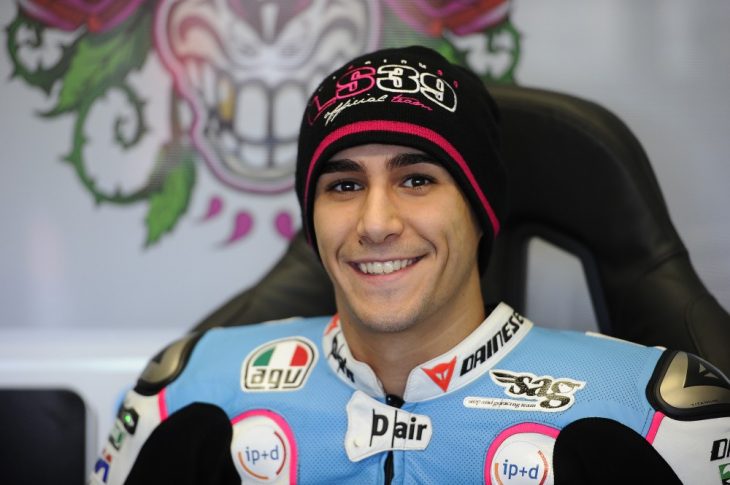
Madrid, Spain, Jun 9, 2016 / 06:02 am (CNA/EWTN News) - Known for kneeling to pray an 'Our Father' before his races, renowned motorcyclist Luis Salom died June 3 after an accident while practicing for Spain's Grand Prix.
The 24-year-old once told the press that he prayed not to win but “because I really believe and it's my aim to ask that that everything goes well, that nothing happens, and so we can all finish the race.”
“I do it because I want him to protect me, so that nothing happens to me and so that I will come back home safe and sound,” he told OK daily. Salom, nick-named locally as “the Mexican,” was Catholic and did not hesitate to publicly express his faith.
During a practice session Friday at the Montmeló racetrack in Barcelona, Salom could not negotiate a turn and crashed straight into the air-fence barrier at around 90 miles per hour. His mother always attended his races, and was in the stands the day he died.
Salom was born on the island of Mallorca. He was close to becoming a champion in the Moto 3 class in 2012 and 2013, and rose to the Moto 2 class this season.
Besides working to help up-and-coming racers from Mallorca, Salom always had time to participate multiple charity events. In recent years, he let various cancer associations use his picture. On Epiphany of this last year, he visited the children's hospital in Mallorca.
The young motorcyclist's funeral is set for June 8 at the Mallorca cathedral.
Meet the Papal Ninja who's taking a hit TV show by storm
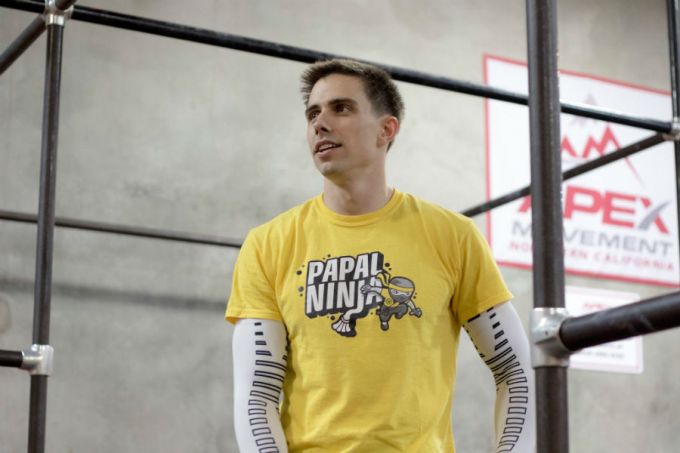
Berkeley, Calif., Jun 8, 2016 / 04:23 pm (CNA) - Two minutes and thirty seconds is all it took for Sean Bryan to complete the Los Angeles qualifier round of American Ninja Warrior.
The season eight premiere of the hit NBC/Esquire show – which follows competitors as they try to complete obstacles courses of increasing difficulty – featured the amateur flying through every obstacle. He even climbed the newly designed, 14.5-foot Warped Wall on his first try.
Bryan claimed 4th place and ranked among the show’s veterans, but something else caught everyone’s attention.
On Bryan’s bright, yellow shirt was written: ‘Papal Ninja’.
“I thought, how could I be a bit more explicit about my faith,” Bryan told CNA, “because it is quite explicit in my life.”
The 31-year-old is an active member of the Catholic Church. His story, and the mystery behind his chosen competition name, were highlighted on American Ninja Warrior this month.
The show explained Bryan’s history as a gymnast for the University of California, Berkley. While studying physics, Bryan competed mostly on parallel bars and rings. His team earned fifth place in the NCAA championship.
It then revealed how Bryan discerned the priesthood with the Salesians of Don Bosco in California. Though Bryan discerned out, the episode showed how he stayed with the Salesians to finish his Masters in Theology with a Salesian Studies Concentration at the Dominican School of Philosophy & Theology.
The episode followed Bryan, who has now earned the degree, as he continues to live with the Salesians and help them as an assistant to the director, and special projects manager. He even turned their garage into an American Ninja Warrior training facility.
Bryan also owns his own freelance design and videography business and works as the project manager for the Lay Mission Project – an initiative by the Western Dominican province, Diocese of Sacramento, Catherine of Siena Institute, Institute of Salesian Studies, and Our Sunday Visitor – to form lay Catholics ‘for the sake of animating the mission of the Church to secular society.’
“The producers really took a liking to my story and they wanted to focus on the Catholic aspect,” Bryan said.
“I totally went along with it because I thought it would be a great idea, because that’s really who I am at heart.”
The Papal Ninja was raised Catholic. He grew up in Cranford, New Jersey and attended Catholic schools much of his life.
“I didn’t really take faith seriously but I started exploring it the last three years of high school,” he said.
Bryan said his faith life changed when the events of 9/11 and a friend’s death unfolded in the same year. With the help of his teachers and a local priest, Bryan was able to process everything and ask questions about the faith.
After high school, Bryan attended Temple University. The same local priest that helped guide him in high school encouraged him to go on a retreat.
“I decided that no, retreats are for Jesus freaks, so I’ll just start going to Mass.”
Over time, Bryan said he started feeling more comfortable in his faith. He was on the gymnastics team at Temple University for two years before transferring to the University of California, Berkeley.
“I saw it as a new beginning,” he said. “I made a new commitment to be myself and part of that is to not worry about what people think, to go to Mass, and to take my faith seriously.”
When he finally decided to go on a retreat, Bryan said he was asked to help lead it.
“I thought, woah, woah, woah, I’ve never been on a retreat before, let alone help lead one.”
“That experience of ministering to people,” he said, “to see the reality, how faith is planning out people’s lives, really impacted me.”
It was then that Bryan began to discern his vocation and thought God was calling him to the priesthood.
“I assumed that if God is giving me the gift of faith to dedicate my life to it, it’s probably the priesthood.”
But after four years of formation with the Salesians, before making vows, Bryan decided religious life was not God’s call for him. While at the Dominican School, Bryan said Father Michael Sweeney O.P., the school’s president, helped him appreciate the importance of the lay role in the Church. Bryan began working on the Lay Mission Project.
Bryan’s family, friends, young people he mentored, and a few Salesians all watched him train for American Ninja Warrior and gave him advice. During the competition, they cheered him on until he hit the red buzzer.
Sharing the moment with his parents, Bryan said, was the most special thing about the whole experience. They traveled from New Jersey to support him.
During the course, Bryan said he just took each obstacle as it came and focused on what was next. Throughout training, he would integrate prayer into difficult activities, make the sign of the cross, ask for protections and strength, and pray to St. Francis de Sales for humility.
“My friend Francis de Sales keeps me on point with respect to enjoying the process,” he said.
When Bryan finished the actual course, he did a backflip and gave God the glory.
“I realized, wow this really did just happen,” he said, “I pointed to the heavens thinking to myself, ‘thank you.’”
Since the episode aired on June 1, Bryan said he has been receiving positive messages from both believers and non-believers. He said he hopes people see that they too can be alive in their faith and that it is not unusual.
“I hope they might be able to see faith as a normal thing,” he said, “as something that doesn’t cast you aside from society, but as a good thing.”
When asked about the inspiration behind the Papal Ninja name, Bryan referenced the laity in paragraph 33 of Lumen Gentium, the Dogmatic Constitution on the Church.
“The lay apostolate, however, is a participation in the salvific mission of the Church itself. Through their baptism and confirmation all are commissioned to that apostolate by the Lord Himself,” the document says.
“We’re all called to be papal ninjas,” Bryan said, “to help accomplish the secular mission of the Church as a lay person.”
Bryan said he will keep training and having fun in order to reach the end of American Ninja Warrior. Though he does not expect to win the million-dollar prize, he said that if he does, he would put the money towards paying off student debt, funding various projects and investing in men’s collegiate gymnastics.
And what does the Papal Ninja think about Pope Francis? Bryan said it would be a great encouragement to hear from the Holy Father – on top of the greatness that is already available in the sacraments.
Follow Bryan’s journey by liking ‘Papal Ninja’ on Facebook, Instagram and Twitter.
How a music professor became a papal knight
By Adelaide Mena
Washington D.C., May 29, 2016 / 05:07 am (CNA/EWTN News) - Growing up in a modest home in southern California, Leo Nestor never imagined that his love of music would one day lead to him becoming a papal knight.
But that’s exactly what happened, as the outgoing music professor at The Catholic University of America received the knighthood upon his retirement, in recognition of his lifetime of work for the Church.
Nestor was inducted as a Knight of the Pontifical Equestrian Order of St. Gregory the Great on May 14, honoring his lifetime of service to the Church through conducting, composing and teaching music.
The order was bestowed upon him by Cardinal Donald Wuerl of Washington at the diploma ceremony for The Catholic University of America’s School of Music.
Asked about the award, Nestor was quick to draw attention away from himself.
“If it stands for anything, it stands for what the Church needs of her people. She needs artists,” he told CNA.
The Order of St. Gregory the Great is granted to individuals for extraordinary service to the Catholic Church. It is one of several order of Pontifical Knighthood, which the Church bestows to continue chivalric traditions and recognize merit and service.
Other orders may be bestowed for military service and protection of the Holy See, reserved specifically for a Catholic’s service to the Church, given only to Catholic heads of state, or granted to members of the clergy.
The Order of St. Gregory, in contrast, can be bestowed upon Catholics as well as non-Catholics. Previous recipients include Eunice Kennedy Shriver, founder of the Special Olympics; Chen Chien-jen, vice president of Taiwan; Carl Anderson, Supreme Knight of the Knights of Columbus; and Polish composer Henryk Gorécki.
Nestor was quick to add that, as an Equestrian Order, members “have the right to ride a horse into St. Peter’s (Square)!”
With the conclusion of the 2016 academic year, Nestor is retiring as a full-time music professor at the university, and will transfer to Professor Emeritus status, although he will still help some students with thesis work and projects.
Looking back at his academic career, Nestor said that the path to teaching and eventually knighthood was set in motion by both choices and the “happenstance” of his surroundings as a child.
“It’s really been a very easy life, because the choices fell logically, aesthetically, theologically, liturgically into place.”
Nestor’s musical life started as a Catholic elementary student in California. He sang in the school choir, and learned music from both a college professor and several nuns at the school. While his family was not wealthy, his parents agreed to go into debt to buy a piano, on the condition that he would promise to practice it.
As a high school freshman, Nestor began studying at the seminary for the Franciscan friars of the Province of St. Barbara, where he learned to play organ, began composing, and met other seminarians who had musical training. He also learned Latin and other theological and academic subjects. Near the end of his training, however, the seminary closed, leaving him to change courses in pursuing the study of music.
After completing his undergraduate degree at California State University, East Bay, Nestor returned to Los Angeles for graduate study. There, he conducted choirs and orchestras for two local parishes.
Nestor was next brought to Washington, D.C. to conduct at the National Shrine of the Immaculate Conception. There, he spent 17 years as music director, right next to the campus of The Catholic University of America, where he also became an adjunct teacher.
After years of working next to the university, Nestor became a full-time professor there. “You love your kids, and over the years that’s been one of the great joys,” he said of teaching.
Over the years, Nestor has also served as an advisor to the U.S. Secretariat for Divine Worship. He has composed music for four papal visits to the United States: St. John Paul II’s visits to Los Angeles (1987) and Saint Louis (1999), as well as the Washington, D.C. visits of Pope Benedict XVI (2008) and Pope Francis (2015).
But the concerts and titles are not what Nestor finds most meaningful. Rather, he said that he is grateful for what the compositions let him offer to God and to teach his students.
He said that in great part, he owes the honor of the papal knighthood to his students, because of what he’s been able to learn with them, but also how he’s been able to serve and teach students to transform the music they work with.
At the university, he primarily taught sacred music and conducting. He described his job as helping students to take the vision of “whomever” – from Palestrina in the 16th century to Stravinsky in the 20th century – and to bring those ideas from the music “into the hearts and minds of these people who are coming to hear you.”
“That is a process that is new and electric at every hearing.”
He also commented on conducting and playing music as spiritually significant events, sacrificially emptying out one’s self to portray the thoughts of the composer, and offering music to one’s audience – or, in the case of the Liturgy, to God.
Reflecting on an accomplished academic and musical career, Nestor said that he hopes his life of work reflects what the laity can offer the Church today.
“In the seminary we learn about the arguments for the existence of God,” he said. “For the artist, one of the easiest is the argument for the existence of God from beauty.”
Pope Francis to author new book answering teens' questions
By Elise Harris
Vatican City, May 29, 2016 / 11:52 am (CNA/EWTN News) - After becoming the first Pope to author a children's book earlier this year, Pope Francis will soon come out with another, based on his responses to questions posed by youth through a new online platform.
Speaking at the May 27-29 World Encounter of the Directors of Scholas Occurrentes, Italian journalist and author Tiziana Lupi explained the idea behind the new book, which she said seeks to “open a door” to dialogue with youth.
Scholas was founded by Pope Francis in August 2013 as an initiative to encourage social integration and the culture of encounter through technology, arts and sports. The foundation has organized several events at the Vatican, including two Google hangout sessions with Pope Francis, as well as 2014’s interreligious Match for Peace.
Both Richard Gere and George Clooney were present for the May 29 meeting between the Pope and participants in the encounter.
Lupi, who works with Italian editorial Mondadori, said May 29 that the publication has joined efforts with Scholas in creating a new technological platform “which allows all youth from all over the world, all social classes, all religious to ask Pope Francis a question without filters.”
While it’s generally journalists who ask the questions, this time it will be the youth who open their hearts to the Pope through the new webpage “Ask Pope Francis,” which is already up and running.
Since there will obviously be too many questions to include all of them in the book, only certain questions, which come more authentically from the heart, will be selected.
“We’ll select the ones that seem more from the heart and which allow Pope Francis to touch on topics he hasn’t been able to until today,” Lupi said, adding that the book will likely be released sometime in October or November.
Pope Francis met with participants in the gathering May 29, which also marked the presentation of the platform the new book project, called “Chiedete” in Italian. In addition to the announcement of the new book, several other projects and initiatives were presented to the Pope.
After hearing the tearful testimony of a teen girl from Mexico who was bullied after coming to the United States following her parents’ separation, the Pope was told that a new anti-bullying campaign was being launched by Scholas with the hashtag “#nosotrossomosunicos,” meaning “#weareunique.”
Following the girl’s testimony, 12 young, influential Youtube users from around the world asked the Pope how to build a better, more diverse and integrated world.
In his response, Francis said that each person must be recognized for their own personal identity, explaining that “there is no future” if a person lacks a clear identity.
He spoke of the importance of the “language of gestures” in making someone feel included. These gestures, he said, can be “pat, a smile, a smile that gives hope, looking into one’s eyes. Gestures of approval or patience, tolerance.”
If bullying is ever going to stop, we must leave aggressions behind, he said, adding that “bullying is an aggression that hides a profound cruelty.”
“The world is cruel. Wars are monuments of cruelty,” he said, and pulled out from his pocket graphic pictures sent to him by a nun living in an African country torn apart by civil war.
Showing the pictures to the participants, Francis lamented how they depicted grotesque images such as a child with their throat cut and another “butchered in the head.”
“If this happens, how will bullying not? It’s the same cruelty,” he said, explaining that if we want to build a better world, we must first eliminate “all forms of cruelty. War is a form of cruelty.”
Instead of aggression, we must gain the ability to listen to one another and to dialogue, rather than argue, he said, telling attendees “don’t be afraid of dialogue,” because with dialogue “everyone wins, no one loses.”
Pope Francis also stressed the importance of leaving one’s pride and superiority behind, because these attitudes “always end badly.”
The world today “needs to lower the level of aggression, it needs tenderness, it needs to listen, it needs to walk together,” he said, and, pointing to the photos, said added that “this is happening today because all these attitudes are lacking.”
Francis was then presented with several other initiatives before receiving a signed copy of all the commitments made by participants during the three-day gathering.
Mention of the second interreligious Match for Peace, to be played June 10 in Rome’s Olympic Stadium and which draws together major soccer stars from around the world, was also mentioned.
The Pope closed the gathering by offering his gratitude to participants for their prayers and work, and praying for youth around the world.
For Iraq's Christians, what comes after Islamic State?
By Matt Hadro
Washington D.C., May 31, 2016 / 05:01 pm (CNA/EWTN News) - With thousands of displaced Christians in Iraq subsisting on humanitarian aid, advocates are asking if they have a future there once the Islamic State is removed – and what that might look like.
“We should prepare now for the consequences of the liberation of ISIS-controlled areas, including Mosul and the Nineveh Region, as well as regions in Syria,” stated Carl Anderson, Supreme Knight of the Knights of Columbus, at a May 26 hearing on “The ISIS Genocide Declaration: What’s next?” on Capitol Hill.
And Dr. Tom Farr, director of the Religious Freedom Project at Georgetown University, insisted that a “post-ISIL order” in the region must bring about “pluralism, self-governance, and stability” in a April 28 address at the Permanent Observer Mission of the Holy See to the United Nations.
After overrunning large swathes of Iraq and Syria in 2014, Islamic State reportedly lost a fifth of its caliphate territory by this past March. The onslaught created a refugee crisis, however; when Islamic State took the Iraqi city of Mosul and the Nineveh Plain, hundreds of thousands of Christians fled eastward into Iraqi Kurdistan. There, refugees in Erbil have been living in makeshift dwellings for almost two years.
They depend largely on humanitarian aid from churches and non-governmental organizations, and their situation is precarious.
However, the focus on providing for the short-term needs of refugees cannot replace the longer-term strategy of creating a stable, prosperous, pluralistic society once the Islamic State is gone.
Many displaced Christians have already left the region, seeking asylum or re-settlement elsewhere. However, like in Erbil where over 70,000 displaced persons now live, many are simply living in shipping containers and cannot provide for themselves.
Plans must be in place to re-settle Christians who want to stay, advocates insist. “People should be allowed to decide their own future,” Anderson stated.
“There has been much debate concerning plans for victims of genocide in Iraq,” he continued. “Some have argued for returning people safely to the Nineveh Region, others that they should be allowed to stay in Kurdistan, still others that they be allowed to immigrate. But these are not necessarily mutually exclusive, competing proposals.”
Except that in the case of the many Christians who fled Mosul, they can’t go home. Even if the Islamic State is driven from the city, probably not without a great struggle, the bonds of trust between the Christians and their Muslim former neighbors have been severed, perhaps for good, after those same neighbors turned them in to Islamic State forces back in 2014.
So even if their homes are intact, Christians cannot necessarily go back and live among their former neighbors. Another option must be found.
On May 19, the National Defense Authorization Act, a defense spending bill, passed the United States House. Attached to it were two amendments inserted by Rep. Jeff Fortenberry (R-Neb.).
Fortenberry’s amendments created a blueprint for the future of the region. “First, the United States strategy in Iraq now includes securing ‘safe areas’ so that genocide victims can return to their homelands,” he stated. And “second, a new provision empowers minority groups, including Christian and Yezidi security forces, in the integrated military campaign against ISIS.”
“Christians, Yezidis, and others should remain an essential part of the Middle East’s once rich tapestry of ethnic and religious diversity,” he added.
However, the Christian communities of Northern Iraq have been steadily dwindling since the 2003 US-led invasion of the country. If refugees are not re-settled in the area soon, and if they remain indefinitely in makeshift dwellings and refugee camps, then they could leave Iraq for good and the communities could disappear altogether.
This would be catastrophic for the future of the Middle East, Farr insisted at the UN; it would portend “the destruction of religious pluralism, and with it any opportunity for stability, stable self-governance, and economic development.”
Some, like Farr, have floated the idea of “an autonomous, multi-religious, multi-ethnic ‘safe zone,’” to be set up in order to keep Christians in their ancestral homeland and not disperse the communities that have lived there for centuries. If set up like past safety zones, international peacekeeping forces would be appointed to protect genocide victims in an area removed from the conflict against Islamic State.
A lot would have to be accomplished for this to be a viable plan, Farr acknowledged. Aside from military protection there would have to be “an internal police force, economic revitalization, just and effective governance, treatment for trauma and psychological distress, and mechanisms for reconciliation.”
Neighboring countries would have to accept the plan, along with Iraqi Kurdistan and Iraq’s central government, he added.
After a period of time, the “safe zone” could hopefully become semi-autonomous province, Johnny Oram, executive director of the Chaldean-Assyrian Business Alliance, stated in his written testimony at the May 26 hearing.
The land would have “some semblance of self-governance and self-security,” he explained, and would be “the only way to regain the trust of the minorities who feel they were betrayed by the Iraqi government and the KRG [Kurdistan Regional Government].”
However, Stephen Hollingshead of the advocacy group In Defense of Christians has a different vision for the Christians in the area. “UN ‘safe zones’ have a very checkered past of success,” he said. “They tend not to be safe, and they are, with one possible exception, never economically self-sufficient.”
Hollingshead is the managing director of the IDC’s Haven Project. Instead of starting with a “safe haven,” he explained, he would like to immediately transition the land into a self-sufficient place for Christians and other ethnic and religious minorities – one village at a time.
Christians here could not only survive, but could flourish and be self-sustaining, protecting themselves and providing for themselves and trading with partners in the region, he said.
The Nineveh Plain, which lies between Mosul to the west and Iraqi Kurdistan to the north and east, is the target for this endeavor. Christians could cultivate the fertile and and produce goods for international markets while policing and protecting themselves.
There are, of course, many variables. The Kurdish Peshmerga, “if left to themselves,” Hollingshead stated, will simply annex the plain once Islamic State is defeated.
That is why Christian and Yazidi militias must partake in the fight against Islamic State, he insisted: “If the Christians and the Yazidis, who owned the place, do not actively participate in the re-taking of the place, then they won’t have a seat at the table in deciding what happens.”
“I believe that the Kurds would be willing to do a deal – and I’m asking the U.S. government to make such a deal,” he continued. If the Kurds agree to relinquish their claim to the plain in exchange for the U.S. recognizing their right to self-determination, such an agreement could come about.
This is no certain proposition – Christians in the region still remember Kurdish participation in the genocide of Assyrian Christians a century ago.
And they are still wary of the Peshmerga today, according to Naomi Kikoler, deputy director of the Simon Skjodt Center for the Prevention of Genocide at the U.S. Holocaust Memorial Museum.
“Religious minorities continue to feel little trust towards the Iraqi Security Forces and Kurdish Peshmerga who they feel abandoned them when IS attacked Ninewa,” Kikoler stated in her May 26 written testimony before the House Foreign Affairs Committee.
“Many also continued to feel that they are being used as political pawns by the government of Iraq, and the Kurdish regional government, in the ongoing contest over the disputed areas, this leaves them nervous about who and how their land will be administered should they return home.”
Yet the plan may be the Christians’ best bet in the long-term in the interest of stability, peace, and prosperity, Hollingshead insisted.
“A haven is a place where security fosters productivity,” he said. If there is mutual prosperity among Assyrian Christians, Kurds, and other minorities in the region, that will breed security. “You don’t shoot people you trade with.”
How might it happen? “Start small,” he insisted. The U.S. and local militia could identify one village on the plain that could be retaken. The Peshmerga and other Christian militia fighting with them would clear Islamic State occupiers from the village with the help of U.S. air strikes – similar to how Mount Sinjar was relieved from ISIS occupation, Hollingshead said.
Once the village is cleared, foreign and local investors would be identified to provide local entrepreneurs the capital they need to start businesses and create jobs.
Regardless of whether they’re in an independent Christian province, jobs are absolutely crucial in any long-term solution for the region, Hollingshead maintained. “What they really want,” he said, “is an opportunity to earn their daily bread.”
They deserve a fighting chance to either directly participate in the military action to retake Nineveh or at the very least to become entrepreneurs in the region, he added.
Regardless of the long-term strategy – a UN “safe zone” or a Christian-settled Nineveh Plain -- the international community and especially the U.S. must watch the region closely, experts say. This must be done to establish security and justice and ensure that property rights are honored by the local courts.
Pope Francis: Pray to God, not to a mirror
Vatican City, Jun 1, 2016 / 06:59 am (CNA/EWTN News) - One who prays with humility and awareness of his or her sin speaks to God, Pope Francis said on Wednesday, whereas one who prays with arrogance and self-righteousness is speaking to a mirror.
“It is not enough to ask ourselves how often we pray,” the Pope said to the thousands of people gathered in St. Peter's Square for the weekly general audience. “We must also ask ourselves how we pray, or rather, how our heart is.”
The pontiff centered his June 1 catechesis on Jesus' parable of the tax collector and the pharisee.
The problem with the pharisee – who stands in the temple and gives thanks for not being like other sinners – is that, as he prays to God, he looks at himself, Francis said.
“Instead of having the Lord before his eyes, he has a mirror,” the Pope said. When he prays, the pharisee lists his good deeds, and is made happy by following “precepts.”
“Yet, his attitude and words are far from the way of acting and speaking of God, who loves all men and does not despise sinners,” Francis said.
Thus, this pharisee, who believes he is just, “neglects the most important commandment: the love for God and for neighbor.”
Francis said we must examine our thoughts and feelings, eradicating “arrogance and hypocrisy.” We cannot pray with arrogance or hypocrisy, but rather “we must pray before God as we are,” he said.
The tax collector, on the other hand, is shown to be humble, asking God for mercy.
Francis invited the crowds to follow the example of the tax collector, and repeat after him three times: “Lord, be merciful to me, a sinner.”
The parable, he said, teaches that being righteous or sinful has nothing to do with social status. Rather, it has to do with the way we relate to God and to our neighbors.
“The tax collector's humble gestures of penance and (these) few simple words,” Francis said, demonstrate his awareness of his “miserable condition.”
“His prayer is essential. He acts out of humility, secure only in being a sinner in need of mercy,” and in the end, he “becomes a symbol of a true believer.”
In contrast, “the pharisee is the symbol of the corrupt pretense of praying, but only succeeds in showing off in front of a mirror.”
“Pride affects every good deed; it empties prayer,” and keeps God and others at a distance, Francis said. Humility, on the other hand, is necessary in order to receive mercy.
God has a “weakness” for humility, the pontiff said. “Before a humble heart, God opens his heart completely.”
Later in the audience, Pope Francis remarked that Friday marks the Solemnity of the Most Sacred Heart of Jesus, as well as the start of the June 1-3 Jubilee for priests.
He invited everyone to dedicate the month of June to praying to the Sacred Heart, and “to support the closeness and affection of your priests, so that they may always be in the image of that Heart full of merciful love.”