



This bishop in India is donating his kidney to save a Hindu life 

By Antonio Anup Gonsalves

Palai, India, Jun 1, 2016 / 11:09 am (CNA/EWTN News) - A Syro-Malabar Catholic bishop from the southern Indian state of Kerala has a special way to celebrate the Year of Mercy: he is donating his kidney to save a young Hindu man battling for his life.

“I have no anxiety about the surgery, and it’s only a simple sacrifice for a fellow being,” Bishop Jacob Muricken, 52, told CNA. He is an auxiliary bishop of the Sryo-Malabarese Diocese of Palai.

He will donate his kidney to save 30-year-old Sooraj Sudhakaran. The young man is from Kottakkal, another city in Kerala, about 120 miles northwest of Palai.

Sudhakaran is the only breadwinner of his family, and supports his wife and his mother. The low-cast Hindu man has lost his job, and sold his house to pay for the treatment costs of dialysis. He was diagnosed with kidney failure two years ago.

“If I can save the life of Sudhakaran, a family would be saved,” Bishop Muricken said.

The procedure is taking place June 1 at a private hospital in Kochi, another city in Kerala. Bishop Muricken has helped to pay for lab tests as well as ancillary costs for the treatment.

For his part, Sudhakaran has thanked the bishop for offering to save his life.  

Fr. Anithottathil Gervasis, secretary of the Palai diocese, reflected that “This is a great selfless act of Bishop Muricken in the spirit of the Year of Mercy. Bishop Muricken’s generosity has practically taught us a moral example in reaching out to save life.”

Fr. Gervasis said the bishop’s act is no publicity stunt, and that he is regarded as one of the simplest persons among the bishops. He added that the bishop is happy and has only asked for prayers so that he could continue to work and be a witness for Christ and to his people.

Bishop Muricken was himself inspired to kidney donation by Fr. Davis Chiramel, founder of the Kidney Federation of India. The organization has arranged for 15 priests and six religious sisters to donate their kidneys to unrelated, needy recipients.

A year ago Bishop Muricken attended a seminar on organ donation organized by Fr. Chiramel, and he took the challenge personally.

People of diverse beliefs have praised the bishop’s plan to donate his kidney.

“Donating an organ while living to save a life requires tremendous courage and is worth more than donations of money or wealth to institutions,” Anil Belurkar, a local businessman, told CNA.

“The bishop, in his own way, has set a great example especially for all types of leaders to set love in action rather than merely preaching by words,” Anil added.

He said Bishop Muricken's act would help break down taboos in India against organ donation.

Catholic man sentenced to attend Baptist church services – for real 

Cincinnati, Ohio, Jun 2, 2016 / 03:02 am (CNA/EWTN News) - An Ohio judge sentenced a 23-year old Catholic man to 12 consecutive Baptist Sunday services after an altercation in downtown Cincinnati in January.

It was dollar beer night at the Cincinnati Cyclones vs. Fort Wayne Komets hockey game on January 23, and Jake Strotman and his buddies had had a few before heading downtown after the game (a Cyclones victory).

Strotman and his friends came across a group of Baptist street preachers, who Strotman claims were condemning him, according to the Cincinnati Enquirer.

Already a curious and outgoing person, Strotman engaged with the preachers and “gave them my two cents worth.”

“They were telling me I was going to hell,” Strotman told Enquirer reporters. “I was asking them: 'Why do you think you can condemn people?' I didn't understand why they thought they could judge me.”

Hearing the argument, another man approached the street preachers and “started going off like a ball of fire,” Strotman said.

Amidst threats, shouting, pushing and shoving, Strotman ended up face-down on the asphalt and pushed his hand down on one of the preacher's face, Joshua Johnson, as he was getting back up. Johnson claims that in doing so, Strotman shoved Johnson’s own glasses into his face, cutting him.

Last week, Ohio Judge William Mallory, convicted Strotman of attempted assault, a misdemeanor. Mallory, who reportedly enjoys handing out creative sentences, said in the courtroom that while 90 days of jail time was an option, he was open to other ideas.

"I'm trying to get to something reasonable here. And I'll be honest with you guys, sometimes in certain places people don't want to be preached to. You agree with that right?" Mallory reportedly said to Johnson in court.

That’s when Strotman, a self-employed salesman of windows, siding and doors, proposed his own alternative sentence: serving at a church of Mallory’s choosing.

Mallory approved, and sentenced Strotman to attend 12 consecutive Sunday services at Morning Star Baptist Church. He must attend each entire 90-minute service (for a total of 18 hours) and have the weekly program signed by the minister.

He also paid $480 in court fines and a $2,800 lawyer bill.

"Three months, that's not that bad,'' Strotman told the Enquirer. "I think it's a nice example of hearing people out instead of getting angry and jumping to conclusions.”

"I'm going to listen with both my ears and keep my mouth shut,'' he said. "Then, maybe I'll try to sell them some windows."


Pope Francis offers prayers following EgyptAir plane crash 

Vatican City, May 20, 2016 (CNA/EWTN News) - Pope Francis has voiced his prayers and condolences to all those affected by the apparent crash of an EgyptAir plane in the Mediterranean Sea Thursday morning.

“Having learned with sadness of the tragic crash of the Egyptian passenger airliner, Pope Francis wishes to assure you of his prayers and solidarity at this difficult time,” said a telegram from Vatican secretary of state Cardinal Pietro Parolin to Egyptian president Abdel Fattah el-Sisi.

It added that the Pope “commends the souls of the deceased of various nationalities to the mercy of the Almighty.”

“Upon the relatives of the passengers and all those involved in the search and rescue efforts, His Holiness invokes the divine blessings of strength and peace,” the telegram said.

Early Thursday morning, an Airbus A320 disappeared while traveling from Paris to Cairo.

Flight MS804 have been carrying 66 passengers and crew. According to Greek authorities, radar showed it making two sharp, zig-zag and dropping some 25,000 feet before falling into the sea.

International military units are searching the area, looking for wreckage and clues to what happened in the plane’s final hour.

The cause of the crash remains unknown. Egyptian authorities say terrorism is more likely than a technical failure, although no terrorist group has claimed responsibility for the act.

Investigations are also underway to determine whether a security breach occurred in Paris’ Charles de Gaulle airport.


Judge Bonilla needs a hug

A bizarre ruling in Colombia bans civic prayer...and hugs 

By Walter Sánchez Silva

Cartagena, Colombia, May 20, 2016 / 03:02 am (CNA) - In what's been labeled an “absurd” move, a judge in Colombia has banned prayer and “fraternal hugs” at the start of Cartagena city council sessions as well as local educational institutions.

The ban on civic prayer – as well as the baffling prohibition against “fraternal hugs” anywhere from businesses to private family life – has generated immense controversy and protests among Christians on the country's coast.

Judge Alejandro Bonilla Aldana's May 10 ruling suspends the first article of a 2007 accord which established prayer at “the beginning of all daily activities in local government entities as a basic approach to recovering the religious principles of the city.”

The daily El Colmbiano reported that a lawsuit against the accord was filed by Miguel Ángel Garcés who is connected with the Autonomous University of the Caribbean. Garcés took up the charge against the accord after a similar effort was rejected by the court in 2015.

The ruling by Judge Bonilla also eliminates “giving a fraternal hug at the beginning of activities” not just at the city council, but also in “public and private businesses, educational institutions, police command posts and stations, military battalions, assemblies, the boards of businesses, shopping centers, and taxi stations, trade organizations, associations and in the family.”

According to the magistrate, “the custom of prayer cannot be taken as a widespread cultural element and the civil authorities cannot impose its obligatory exercise, disregarding freedom of belief.”

Catholic and inter-denominational leaders have largely decried the ruling, with the Archdiocese of Cartagena issuing a statement saying it violates the human rights “of all the Catholics in Colombia.”

The daily El Tiempo reported that “massive prayers” are taking place in Cartagena by diverse Christian groups such as the one led by pastor Lida Arias. “No one can prohibit us from praying and giving hugs,” Arias said. “This city and this country need more prayer and less absurd laws.”

The Colombian coast daily El Heraldo indicated that a number of council members such as  Duvina Torres, Jorge Useche, Erick Piña and Angélica Hodeg have publicly come out against Judge Bonilla's decision.

For their part, the Association of Evangelical Ministers in Bolivar said that “prayer and a fraternal hugs break down the barriers between people and allow us to forgive one another.” They encouraged “a peaceful protest of prayer and fraternal hugs be held in every area of Cartagena.”


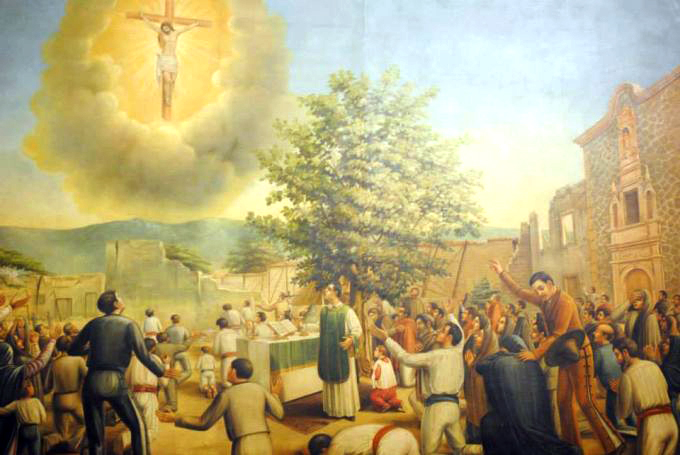
That time Jesus appeared in the sky of Mexico 


Lima, Peru (CNA/EWTN News) - It's a major miracle that you've probably never heard of.

On Sunday, Oct. 3, 1847, more than 2,000 people in Ocotlán, Mexico saw a perfect image of Jesus Christ crucified that appeared in the sky for more than 30 minutes.

Approved by the Archdiocese of Guadalajara in 1911, the phenomenon is known as the “Miracle of Ocotlán” and took place one day before an earthquake that killed 40 and left the town in Jalisco State in ruins.

Before the start of Mass at the cemetery of the Chapel of the Immaculate Conception – presided over by the parochial vicar, Father Julián Navarro – two white clouds joined together in the northwest sky, where there appeared the image of Christ.

Those present and in nearby towns were deeply moved, made acts of contrition, and cried out begging, “Lord, have mercy!” This apparition of Christ was called “the Lord of Mercy” and in his honor, in September 1875, a new parish church was blessed, consecrated and dedicated to him.

Also among the faithful who witnessed the miracle were Father Julián Martín del Campo, pastor of the community, and  Antonio Jiménez, the town's mayor. Both of them sent letters to their respective superiors telling what had happened.

After the miracle, a record of the event was written down with 30 eye-witnesses attesting. Fifty years later, in 1897, by order of the then-Archbishop of Guadalajara, Pedro Loza y Pardavé, another record of the event was made, with 30 additional persons including five priests.

On Sept. 29, 1911, the Archbishop of Guadalajara at that time, José de Jesús Ortiz y Rodríguez, signed a document validating the apparition of Jesus Christ at Ocotlán, and the devotion and veneration given by the people of that area to the venerated statue of our Lord of Mercy located in the shrine of the same name.

“We must acknowledge as an historical fact, perfectly proven, the apparition of the blessed image of Jesus Christ Crucified…and that it could not have been the work of an hallucination or fraud, since it happened in broad daylight, in the sight of more than 2,000 people,” the cardinal said.

He also stated so that the Lord of Mercy would never be forgotten, the faithful must “gather together in whatever manner possible, after purifying their consciences with the holy sacraments of Penance and
Holy Communion and solemnly swear in the presence of God, for themselves and their descendants, that year after year they will celebrate the October 3 anniversary.”

After its approval and to comply with the provisions of the Archbishop of Guadalajara, in 1912 they began public festivities in honor of the Lord of Mercy, recalling the Miracle of 1847. The celebrations currently last 13 days, from Sept. 20 to Oct. 3.

Later, in 1997, Saint John Paul II sent his Apostolic Blessing to the people of Ocotlán on the occasion of the 150th anniversary of the miracle.


This Saint Bernard just met Pope Francis

Bottom of Form

Top of Form

Bottom of Form

Vatican City (CNA/EWTN News) -- While Pope Francis might have chastised animal-lovers who treat their pets better than people in last week’s general audience, that didn’t stop him from giving a good pat on the head to Magnum – the Saint Bernard with VIP access to today’s audience.

Magnum is quite literally a “Great Saint Bernard.” Bred by an order of priests known as Augustinian Canons, he was born on the Great Saint Bernard Pass, one of the highest passes in the Alps connecting Switzerland and Italy.  

He is also a descendant of Barry, one of the most famous St. Bernard rescue dogs known to history.

Long before Beethoven drooled his way onto the big screen, Saint Bernard dogs had been made famous by the Augustinians for a more noble cause: saving lives.

Since the early 18th century, the Augustinian monks who lived in the treacherous Great Saint Bernard Pass kept the dogs in order to help them on their rescue missions to save stranded travelers after bad snowstorms.

Sitting just over 8,000 feet above sea level, the pass stretches 49 miles and in previous centuries was an extremely dangerous route to take. So in order to help travelers who met trouble along the way, Augustine monk St. Bernard de Menthon founded a refuge and monastery around the year 1050.

It wasn’t until sometime between the years 1660-1670 that the monks at what become known as the “Great St. Bernard Hospice” acquired their first dogs, who for the next 150 years served as both companions, scouts and rescuers for travelers in trouble.

A “hospice” at that time was a lodging for travelers. If the dogs found an injured traveler stuck in the snow, one would typically lay on top of the person to keep them warm, while another would return to the hospice to alert the monks that someone was stranded.

Perhaps the most famous of the St. Bernard rescue dogs was Barry, who lived in the monastery from around 1800-1812, and saved the lives of more than 40 people. In total, the St. Bernard rescue dogs are credited with saving roughly 2,000 lives.

Magnum was present at the Pope’s general audience through the help of UNESCO, who not only wanted to honor the memory of his the dog’s famous ancestor, but also garner support for their effort to declare the Great Saint Bernard Pass a World Heritage Site.

Pioneering the effort is the “Barry Foundation,” which was established in 2005 to take over the breeding of the dogs and to ensure they have some social occupation.

With the support of Pierre-Yves Fux, Switzerland’s Ambassador to the Holy See, the foundation was able to organize the visit to Rome.

In addition to Magnum, others accompanying him to meet the Pope included a Swiss-Italian delegation composed of politicians and representatives of various organizations linked to the dogs and the Saint Bernard Pass.


What did Pope Francis actually

say about the female diaconate? 

by Elise Harris

Vatican City, May 13, 2016 / 04:55 am (CNA/EWTN News) - Update: Fr. Federico Lombardi stated May 13 that "one must be honest: The Pope did not say he intends to introduce the ordination of female deacons and even less did he talk about the ordination of women as priests. In actual fact, talking about preaching during the Eucharistic celebration, he let them know that he was not considering this question at all." Fr. Lombardi added that "it is wrong to reduce all the important things the Pope said to the religious women to just this question."

Yesterday Pope Francis raised eyebrows around the world after declaring his openness to establishing a commission to study the female diaconate, but a careful look at his full response is less of a shocker, and points to nothing new.

In fact, in addition to giving a brief summary of a deaconesses' duties in the ancient Church, the Pope suggested that in modern times, nuns perhaps already fill the role.

“(The question) touches the problem of the permanent diaconate. One could say that the 'permanent deaconesses' in the life of the Church are the sisters,” he said May 12, with a laugh.

"What were these deaconesses? Were they ordained or no?” he asked, and noted that the Council of Chalcedon in 451 spoke about the topic, but was “a bit obscure.” It is because of this obscurity the Pope said he wanted to form a commission to study the topic.

Francis’ comments came in response to a question posed by a sister and member of the International Union of Superiors General (UISG), who met with the Pope May 12 as part of their May 9-13 Plenary Assembly, which focuses largely on the role of women in the Church, and obstacles hindering it.

Francis’ lengthy discussion with the sisters consisted of four questions that touched on the lack of consecrated and lay women in decision-making roles in the Church, how to better insert women into the life of the Church, as well as the temptations of both feminism and clericalism.

In the question on deaconesses, the sister asked why the Church doesn’t include women in the permanent diaconate, since they already work with the poor and sick, and, in some cases where there is no priest, distribute Communion, lead prayer services and even give the equivalent of a small homily.

“What stops the Church from including women from being permanent deacons, like in the ancient Church? Why not form an official commission to study the question?” the sister asked.

Part of the Church’s sacrament of Holy Orders, the diaconate is currently only open to men.

Pope Francis said the topic of the female diaconate was something that interested him a lot when he came to Rome for meetings. He usually stayed at the Domus Paolo VI residence on this trips, and there met a Syrian theologian who was an expert on the topic of the permanent diaconate.

After asking the man, whom he described as “a good professor, wise, a scholar,” about the role of female deacons, Francis said the answer he got was that their role in the early Church was “to help in the baptism of women, in the immersion…for decency,” and to anoint women's bodies.

In addition to assisting with the full-immersion baptisms of women, deaconesses would also serve as an aide to the bishop in determining the authenticity of domestic abuse, he said.

The Pope recalled how the Syrian professor told him that “when there was a matrimonial judge because the husband beat the wife and she went to the bishop to complain, the deaconesses were in charge of looking at the bruises on the woman’s body from her husband’s beatings and informed the bishop.”

“This, I remember,” he said, noting that while the Church has already published documents on the topic of the permanent diaconate which touch on the topic of deaconesses, including a 2002 document from the International Theological Commission, the conclusion for modern times was still “unclear.”

The document, which gave a thorough historical context of the role of the deaconess in the ancient Church, overwhelmingly concluded that female deacons in the early Church had not been equivalent to male deacons, and had “no liturgical function,” nor a sacramental one.

It also maintained that even in the fourth century “the way of life of deaconesses was very similar to that of nuns.”

However, given the lack of clarity on the issue today and due to the fact he was only speaking on the basis on his conversation with the Syrian professor, Francis said that “I think that I’ll ask the Congregation for the Doctrine of the Faith to refer me to the studies on the issue.”

He also voiced his desire “to establish an official commission to clarify this point. I am in agreement, and I will speak to do something of this kind.”

“To me it seems useful to have a commission that clarifies this well, above all regarding the ancient times of the Church.”

In her question, the sister also asked the Pope to give an example of where he sees “the possibility of a better insertion of women and women consecrated in the life of the Church.”

While concrete areas of insertion didn’t immediately come to his mind, the Pope said that “consecrated women must participate” in consultations and assemblies with religious, “this is clear.”

Women, he said, see things “with a different originality than that of men, and this enriches: both in consultations and in decisions, and in concreteness.”

The work consecrated women carry out with the poor and marginalized, in teaching catechesis and accompanying the sick and the dying, “are very maternal works, where the maternity of the Church can be expressed more,” he said.

Updated May 13, 2016, 16:28 MDT to include Fr. Lombardi's comments.


A young woman chose to be euthanized,

and the reason why is awful 

By Mary Rezac

Amsterdam, Netherlands, May 15, 2016 / 04:00 pm (CNA) - A Dutch woman in her 20s was euthanized after her mental health condition was declared “insufferable” by a team of doctors and psychiatrists in the Netherlands, according to recently released reports from the Dutch Euthanasia Commission.  

Why? The unnamed woman was sexually abused from ages 5 to 15.  

As a result, she suffered from post traumatic stress disorder (PTSD), anxiety, and other mental illnesses. Multiple reports say the documents classified her condition as “incurable,” thus legally justifying the woman's death by euthanasia under Dutch law.

Health professionals and advocates in the United States argue that the case is a blow to others who are suffering with similar illnesses, because it sends a message of hopelessness.

“I think it's devastating in the message that it sends,” aid Dr. Greg Bottaro, a clinical psychologist with the CatholicPsych Institute.

“But by putting this out there in this public mindset, it calls into question even more the people who are in despair and it gives them greater reason to believe that it's worth giving up.”  

According to reports from The Telegraph, the documents also reveal that this woman was not an exceptional case, as the number of people with mental illnesses who have died by euthanasia has significantly increased since the practice was first legalized in the Netherlands in 2002.

In 2010, only two people were granted euthanasia due to “insufferable” mental conditions, the number rose to 56 in 2015, according to the Telegraph’s report on the documents from the commission.

Dutch psychiatrist Paulan Stärcke, who has carried out euthanasia requests at the country’s End-of-Life clinic, argues that psychiatrists are “too hesitant” about agreeing to euthanasia for patients with psychiatric diseases, and she told The Telegraph that children as young as 12 should be allowed to request to end their lives and be taken seriously.

Dr. Bottaro, however, said that the pro-euthanasia mindset is not only a political agenda, it’s a dangerous threat to public health.

“It’s really a threat to public health itself, because one of the biggest hurdles to get over in treating these illnesses is despair, and a lot of times the first part of treatment is to instill hope that the possibility of healing is there and it's worth working towards, no matter how difficult it might be, that the goal is worth the struggle.”

Dr. Bottaro added that he doesn’t understand how the Dutch medical professionals could reach a diagnosis of “incurable.” While there are complex and severe cases of trauma, he said, there’s never a point where all hope is lost.

“There’s always hope for further treatment,” he said.

Tim Rosales, a spokesperson with the advocacy group Patients Rights Action Fund, said that euthanasia is an extreme and outdated way to handle people’s suffering.

“There are better ways to address the issue of people with serious or terminal illnesses,” he said.

“Assisted suicide is an extreme way that really is outdated, because with modern medicine and modern therapies, doctors are able to care for individuals and their families who are facing those types of illnesses so that they don’t experience pain,” he said.

“I would say that it certainly is not the response, both from a healthcare standpoint or even a compassion standpoint, that society ought to be endorsing.”

Dr. Bottaro said that in light of the news, anyone with a psychological illness needs to know that there is always hope.

“There’s always hope, and the designating of a particular illness as untreatable – it’s a lie. We need to keep pushing forward and keep hoping for healing and working towards it.”

Only a handful of countries have laws allowing for either euthanasia or physician-assisted suicide. Euthanasia differs from physician-assisted suicide in that anyone – a doctor, a family member, the patient – may administer lethal drugs to the patient. Under physician-assisted suicide, the patient’s doctor prescribes lethal drugs, but legally only the patient can administer them to themselves.

In the United States, physician-assisted suicide is allowed under legislation in four states – California, Oregon, Vermont and Washington – with Montana has legal physician-assisted suicide by court ruling.

The release of the documents from the Netherlands comes at a time when Canada’s Parliament is considering a euthanasia law, which is due for a vote in early June. Medical professionals and advocates from Belgium have been releasing a series of videos urging the country not to legalize it.


Breaking: Supreme Court sends

Little Sisters' case back to lower court

By Matt Hadro

Washington D.C., May 16, 2016 / 08:53 am (CNA) - In a unanimous decision, the Supreme Court sent the Little Sisters of the Poor HHS mandate case back to the lower courts on Monday, in light of new developments in the case.

“We are very encouraged by the Court’s decision, which is an important win for the Little Sisters. The Court has recognized that the government changed its position,” said Mark Rienzi, senior counsel at the Becket Fund for Religious Liberty and lead attorney for the Little Sisters of the Poor.

“It is crucial that the Justices unanimously ordered the government not to impose these fines and indicated that the government doesn’t need any notice to figure out what should now be obvious – the Little Sisters respectfully object,” he continued.

Religious charities including the Little Sisters of the Poor had sued the federal government saying that they were being coerced, under threat of heavy fines, to violate their consciences. They said that despite revisions, the Obama administration’s federal contraception mandate requires them to cooperate in actions they believe to be immoral.

The mandate began as part of the Affordable Care Act, which required coverage for preventative care in employee health plans. The Department of Health and Human Services, in its regulations released after the law was passed, interpreted this to require employer coverage for contraceptives, sterilizations, and drugs that can cause abortions.

Churches and their immediate affiliates, like schools and parish groups, were exempt from the mandate but religious non-profits, charities, and universities were not. Some large corporations were exempt from the mandate because their health plans that existed before the health care law were “grandfathered” into its regulations.

Heavy fines are the punishment for not complying with the mandate. Many religious institutions objected to complying with the mandate, saying they were being forced to violate their consciences by providing coverage for practices they believed were immoral. They were being coerced to cooperate in such acts, they said.

After the mandate was issued, the government offered an “accommodation” to objecting parties – they could notify the government of their religious objection, and it would then direct their insurer to provide the mandated coverage free-of-charge. The government argued that contraception can be offered without cost because it reduces later costs associated with births and provides “tremendous health benefits” to women.

The Little Sisters and other charities said this “accommodation” still required them to violate their consciences, because they were effectively acting as “gatekeepers” for the contraception coverage. They also voiced concern that because it was still part of their health plan, they would ultimately end up paying for the coverage they found immoral.

A total of more than 300 plaintiffs have sued to challenge the mandate. In the case currently before the court, Zubik v. Burwell, the Little Sisters are joined by other plaintiffs including the Archdiocese of Washington, Bishop David Zubik of Pittsburgh, the pro-life group Priests for Life, and several Christian colleges and universities.

The Supreme Court, in a rare move in the middle of a case, had ordered both parties to come up with alternative solutions, if possible, of guaranteeing both contraceptive coverage for employees and religious freedom protections for the non-profits.

“Following oral argument, the Court requested supplemental briefing from the parties addressing ‘whether contraceptive coverage could be provided to petitioners’ employees, through petitioners’ insurance companies, without any such notice from petitioners’,” the court’s statement read.

“Both petitioners and the Government now confirm that such an option is feasible.”

The Little Sisters and other plaintiffs, in their brief, outlined an acceptable alternative: when setting up their health plan with their insurer, they would express their wish for a health plan without coverage for the contraceptives, sterilizations and abortion-causing drugs. The insurer would take note and offer employees “cost-free contraception coverage” on the side and outside the health plan.

For their part, “the Government has confirmed that the challenged procedures ‘for employers with insured plans could be modified to operate in the manner posited in the Court’s order while still ensuring that the affected women receive contraceptive coverage seamlessly, together with the rest of their health coverage,” the statement read.

Because of the new developments in the case, the court then sent the group cases back to their respective federal courts – the Third, Fifth, Tenth, and D.C. Circuit Courts of Appeals.

“Given the gravity of the dispute and the substantial clarification and refinement in the positions of the parties, the parties on remand should be afforded an opportunity to arrive at an approach going forward that accommodates petitioners’ religious exercise while at the same time ensuring that women covered by petitioners’ health plans “receive full and equal health coverage, including contraceptive coverage,” the court stated.

The Supreme Court did not say if the government’s mandate and “accommodation” violated the Religious Freedom Restoration Act. Under that federal law passed in 1993, if the government action “substantially burdens” a person’s free exercise of religion, the government must establish that it has a “compelling interest” for the action and that it is using the “least-restrictive means” of furthering that interest.

“In particular, the Court does not decide whether petitioners’ religious exercise has been substantially burdened, whether the Government has a compelling interest, or whether the current regulations are the least restrictive means of serving that interest,” the court stated, leaving that decision for the lower courts.


Rome celebrates the beauty of life

in thousands-strong march 

By Ann Schneible

Rome, Italy, May 9, 2016 / 12:40 pm (CNA/EWTN News) - The greatest challenge in the fight to value and protect human life worldwide is indifference, says one pro-life leader. However, as demonstrated by the internationally-attended March for Life in Rome which on Sunday marked its fourth year, that attitude is beginning to change.

“The March for Life is growing,” said Fr. Shenan Boquet, president of Human Life International (HLI). I’ve been participating now for a number of years. It’s great to see the numbers, and to see especially young people, young families, people getting more involved. It’s an exciting time.”

As in past years, there was a strong international presence at Sunday's march, with some 26 countries represented among the thousands of participants.

First held in Rome on Mother's Day in 2012 (having previously been held in other parts of the country on two other occasions), the annual event was modeled from the U.S. March for Life held each year in Washington D.C. Over the past four years, thousands of people of traveled around from around the world to take part.

The inspiration for the March for Life also came from a challenge made by Pope Benedict XVI, Fr. Boquet told CNA. “That’s how the March actually began,” he said: It “was out of a beautiful fruit of Pope Benedict XVI’s call: get into the public conversation. Get into the public square.”

While the international presence at the March for Life in Rome demonstrates the global concern for the unborn, there are still challenges, said Fr. Boquet – who as HLI president is involved with pro-life initiatives worldwide. One of the greatest challenges in the world today, he said, is “a sense of indifference.”

“Because abortion has become legal in so many parts of the world, and that we see even where it’s not legal groups pushing abortion, and pushing the agenda,” he said, “people have just kind of accepted the fact that: well, this is just the way it is. What can we do about it? How can we change the conversation?”

In the United States, for instance, “there has been a whole generation of people “formed inside that environment. To them it’s common, it’s normality, it’s like having a book on your coffee table. It’s just part of the natural conversation.”

“The challenge, really, is to re-teach the language of life. That is the biggest challenge I see globally.”

This year's March for Life began its peaceful demonstration at the Church of Santa Maria in Cosmedin – best known as the location of the Bocca della Verita, or the Mouth of Truth. The marchers then made their way to St. Peter's Square, just in time to hear Pope Francis “greet the participants in the March for Life” at his weekly Regina Caeli address.

Thousands of people attended the March, Fr. Boquet said, “and it was great to have the Holy Father acknowledge that, and extend his blessing, not only to all the people, but also upon us.”

“That was a confirmation: keep up the good work! Keep marching, keep making that message known.”
Fr. Boquet also spoke of the witness that was made by the March for Life itself to non-participating passersby on the streets of Rome.

“It’s wonderful to watch people on the side,” he said, “which is part of the intention of the March: to kind of interrupt people’s normality, while they’re having their gelato, or their cappuccino, and say: hey, what is all this about?”

“It’s an opportunity to engage without engaging. It’s really exciting to see.”